
Introduction: The Changing Face of Restaurants in Bangladesh
If you look around Dhaka, Chattogram, Sylhet, or even smaller towns like Barishal and Rangpur, you’ll notice one thing: the restaurant industry in Bangladesh is booming. From high-end fine dining restaurants in Gulshan to cozy cafés in Dhanmondi and fast-food outlets in Chattogram’s GEC Circle, the number of eateries has increased drastically in the last decade.
But with this growth comes new challenges. Customers today expect:
Faster service,
Accurate billing,
Hygienic food,
Online ordering and home delivery,
And most importantly, a seamless dining experience.
Unfortunately, many restaurants in Bangladesh are still managed manually. Billing is written on paper, orders are shouted to the kitchen, and owners often don’t know if they’re making a profit or loss until the end of the month.
This is where Restaurant Management Software in Bangladesh steps in. At MNP Techs, we’ve seen firsthand how restaurants can transform their operations with the right technology. A proper restaurant POS software and cloud-based restaurant management system can reduce errors, control inventory, manage staff, and even improve customer loyalty.
Why Restaurants in Bangladesh Struggle Without Technology
Running a restaurant is not just about serving food; it’s about running a complex business operation that involves:
Raw material purchasing,
Kitchen management,
Billing & payments,
Customer service,
Staff management,
Marketing,
Delivery management,
And financial reporting.
When all of this is managed manually, mistakes are unavoidable. Let’s look at the biggest challenges faced by Bangladeshi restaurants:
1. Inventory & Stock Mismanagement
One of the most common problems in restaurants across Dhaka and other cities is stock wastage. For example:
A restaurant buys 50kg of chicken in the morning. By evening, they realize that a large portion has gone missing or expired without proper tracking.
Spices, rice, or beverages are often used without recording.
Staff sometimes misuse or steal items from the kitchen, and the owner never notices.
Without proper restaurant inventory management software, owners lose thousands of taka every month without even realizing it.
2. Manual Billing Errors
Imagine this: a customer orders a few items, and the waiter writes it down on a slip. At the end of the meal, the cashier manually calculates the bill.
Sometimes items are missed.
Sometimes extra items are added by mistake.
Customers get frustrated when bills are wrong.
With restaurant billing software in Bangladesh, this problem is solved instantly. A proper restaurant POS system automatically generates bills, accepts payments via cash, bKash, Nagad, or cards, and keeps everything transparent.
3. Slow Service and Customer Dissatisfaction
In Bangladesh, where competition is fierce, slow service can kill a restaurant’s reputation. Customers expect their food within 10–15 minutes of ordering, but manual order management often delays this.
For example:
A waiter takes an order, but forgets to pass it to the kitchen.
The chef gets confused due to unclear handwriting.
Customers wait too long, get angry, and leave negative reviews on Facebook or Google.
With a kitchen display system (KDS) integrated into restaurant software, orders go directly from the POS to the kitchen screen — no delays, no confusion.
4. High Staff Turnover & Mismanagement
Restaurants in Bangladesh face high staff turnover rates. Waiters, cooks, and cleaners often leave within months, and training new staff is time-consuming.
Without a proper HR & payroll management system, owners struggle with:
Tracking attendance,
Calculating salaries,
Managing shifts.
Restaurant management software solves this by automating staff records, attendance, and payroll.
5. Online Delivery Platforms Taking Over
Foodpanda, Pathao Food, Uber Eats (before it left), and HungryNaki changed the food delivery industry in Bangladesh. But while these platforms bring customers, they also charge high commissions (20%–30%).
Many restaurant owners feel trapped: they want online orders but don’t want to depend only on third-party apps.
With MNP Techs’ restaurant delivery management software, restaurants can:
Take online orders directly through their own website or app,
Manage in-house delivery riders,
Reduce dependency on Foodpanda/Pathao.
6. Lack of Proper Financial Reporting
A shocking number of restaurant owners in Bangladesh don’t know their daily profit or loss. They often wait until the month-end to calculate expenses and revenue. By then, it’s too late to fix issues.
Restaurant ERP software generates:
Daily sales reports,
Expense tracking,
Profit & loss statements,
Tax and VAT records (important in Bangladesh).
This means owners can make data-driven decisions every single day.
7. Rising Competition in Dhaka & Beyond
New cafés, burger joints, and restaurants open in Dhaka almost every week. Customers have endless choices, which means restaurants must work harder to stand out.
Restaurants using modern management software have an edge. They can:
Offer loyalty programs,
Run promotions,
Provide faster service,
Build stronger customer relationships.
Meanwhile, restaurants still using manual systems slowly lose customers.
Why Manual Management No Longer Works in Bangladesh
Bangladeshi consumers are becoming more tech-savvy. They order food online, pay bills through bKash, and leave reviews on social media.
If a restaurant wants to survive in 2025 and beyond, manual systems simply won’t cut it. Owners must embrace cloud-based restaurant management software to:
Save costs,
Increase efficiency,
Keep customers happy,
And grow their business sustainably.
Core Features of Restaurant Management Software in Bangladesh
As the Managing Director of MNP Techs, I’ve had countless conversations with restaurant owners in Bangladesh — from small café owners in Dhanmondi to fine-dining restaurants in Gulshan and hotel restaurants in Cox’s Bazar. They all tell me the same thing: “Running a restaurant is like juggling ten things at once — and if you drop one ball, the whole business suffers.”
That’s exactly why Restaurant Management Software (RMS) was created. A good RMS works like a digital assistant that never sleeps — keeping track of sales, orders, customers, staff, and even raw materials in the kitchen.
Let’s dive deep into the core features that every modern restaurant in Bangladesh should look for in a management software system.
1. Restaurant POS System (Point of Sale)
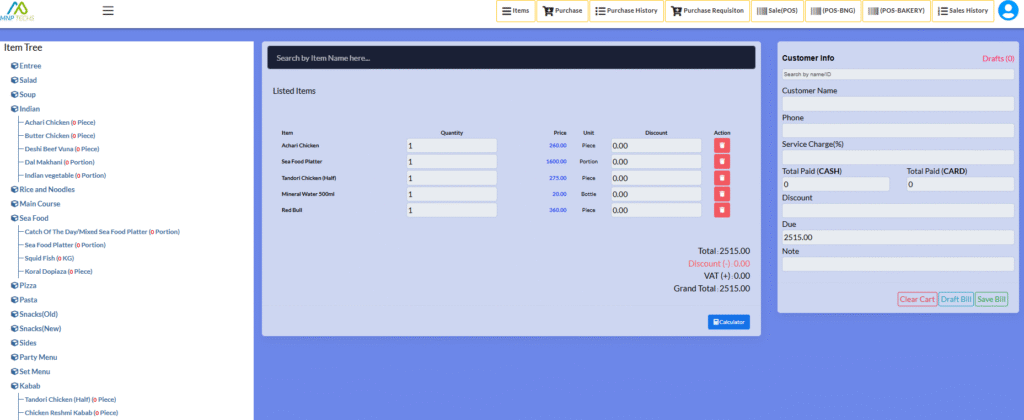
The POS system is the brain of any restaurant software. It’s where billing, order-taking, and payment collection happen.
Why it matters in Bangladesh:
In busy Dhaka restaurants, speed is everything. A cloud-based restaurant POS system ensures bills are processed in seconds.
Customers in Bangladesh prefer multiple payment options — cash, bKash, Nagad, Rocket, card, or even partial payments. A proper POS supports all of them.
Owners can track every sale in real time, whether they are sitting in the restaurant or traveling abroad.
Example:
A café in Banani replaced its manual billing with our MNP Techs POS system. Earlier, customers waited 7–8 minutes for the bill during rush hours. Now, billing takes less than a minute. Customer satisfaction increased, and table turnover improved.
2. Order & Billing Management
Every restaurant owner knows the pain of wrong orders or slow billing. Waiters often miswrite items, forget to add special instructions (like “less spicy” or “no onions”), and customers end up complaining.
With restaurant order management software:
Waiters can take orders directly on a tablet or mobile device.
Orders are instantly synced with the kitchen.
Bills are generated automatically, with VAT included if necessary.
Scenario in Bangladesh:
A family at a restaurant in Uttara orders five different dishes. Without software, the waiter might miss one item. But with POS-integrated order management, everything is recorded digitally, leaving no room for error.
3. Kitchen Display System (KDS)
In most Bangladeshi restaurants, orders are shouted into the kitchen or written on slips. This often leads to:
Confusion,
Wasted time,
Wrong dishes being prepared.
A Kitchen Display System (KDS) solves this problem. Orders appear directly on a kitchen screen as soon as they are taken at the POS. Chefs can mark dishes as “in progress” or “ready,” ensuring smooth communication.
Benefit:
In a busy fast-food outlet in Chattogram, the KDS reduced order preparation time by 30% and eliminated mistakes caused by unclear handwriting.
4. Inventory & Stock Control
This is perhaps the most important feature for Bangladeshi restaurants, because inventory mismanagement is where most money is lost.
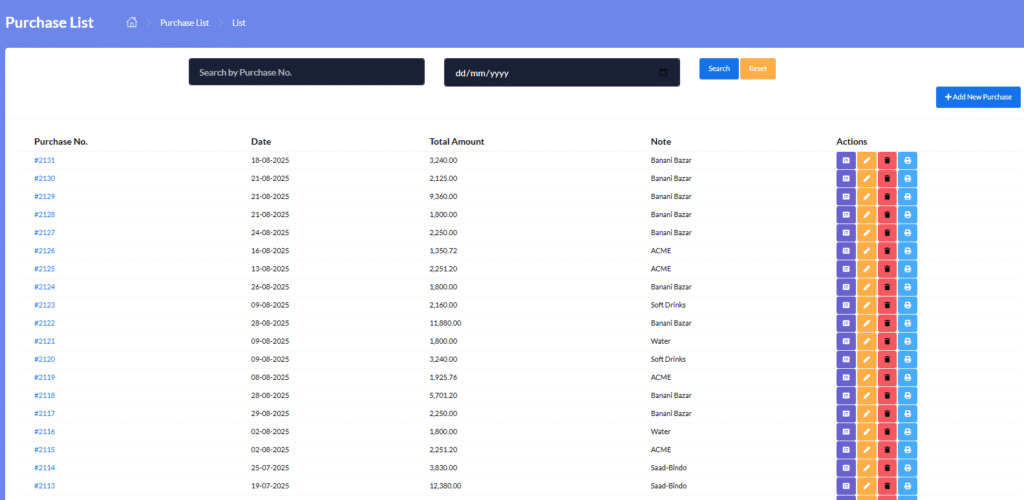
With Restaurant Inventory Software, you can:
Track raw materials like rice, meat, vegetables, and spices in real time.
Get alerts when stock is low.
Monitor wastage and theft.
Calculate food cost per dish (helping you price your menu correctly).
Example:
A biryani restaurant in Dhaka discovered that 10kg of chicken was going unaccounted for every week. After installing inventory software, they tracked usage properly and stopped the loss — saving nearly Tk 20,000 per month.
5. Table Reservation System
In fine-dining restaurants in Gulshan or hotel restaurants in Cox’s Bazar, table reservations are a big deal. Customers don’t like waiting.
With a table reservation system:
Customers can book tables online or via phone.
The restaurant avoids double-booking.
VIP guests can be prioritized.
This improves customer experience and gives restaurants a competitive edge.
6. Multi-Branch Management
Restaurant chains are growing in Bangladesh. Think of brands like Takeout, Madchef, Chillox, or Kacchi Bhai — they have multiple outlets.
For such businesses, multi-branch restaurant software is essential.
Owners can monitor sales, expenses, and stock across all branches from one dashboard.
Branch managers have limited access, while head office controls everything centrally.
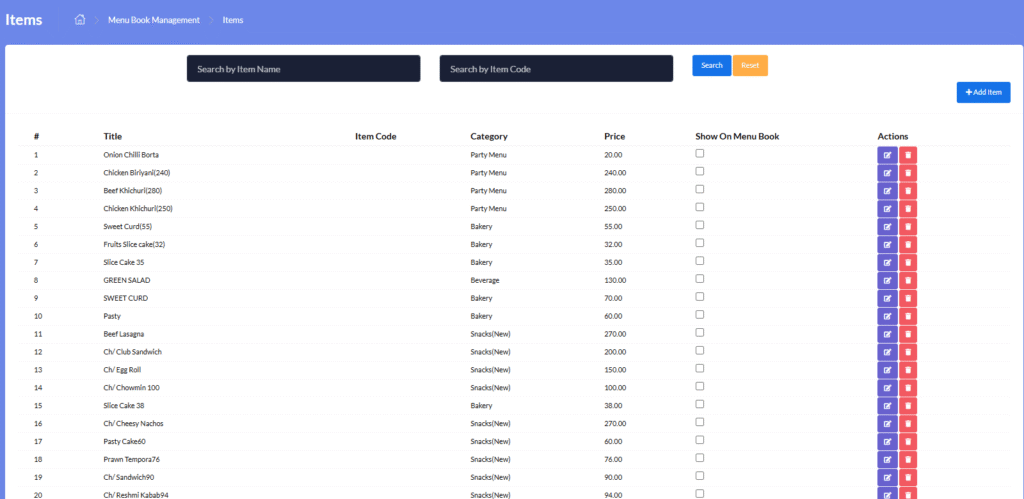
Menu updates can be synced across all branches instantly.
7. Delivery & Online Ordering Integration
Food delivery has exploded in Bangladesh thanks to Foodpanda, Pathao, and HungryNaki. But relying solely on them is risky due to high commissions.
With restaurant delivery management software, owners can:
Accept online orders directly from their website or app.
Manage delivery riders, assign orders, and track them in real time.
Keep 100% of the revenue without giving away commission.
Example:
One restaurant in Sylhet integrated our delivery system alongside Foodpanda. Within three months, 40% of their online sales came directly through their own app, saving them thousands in commissions.
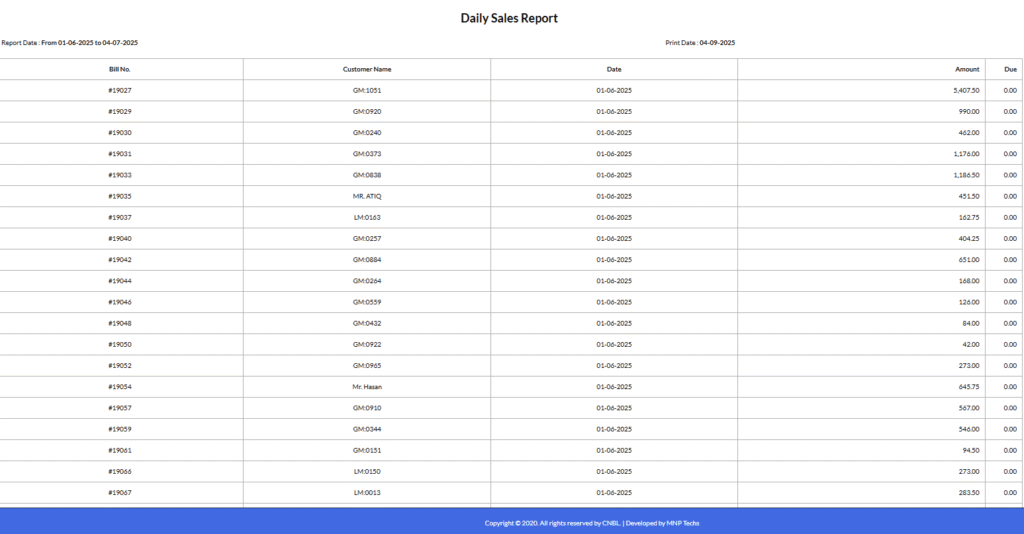
8. Reporting & Analytics
In Bangladesh, many restaurant owners still rely on “guesswork” when it comes to profits. But guesswork leads to mistakes.
With restaurant reporting software:
Owners get daily sales reports automatically.
Expenses and purchases are tracked.
Monthly profit & loss statements are generated.
Best-selling and worst-selling items are identified.
Benefit:
A fast-food chain in Mirpur used our analytics to identify that one of their burgers was not selling well. They replaced it with a new menu item, which increased overall sales by 15%.
9. HR & Payroll Management
Managing staff in Bangladeshi restaurants is always a challenge. With restaurant HR and payroll software:
Staff attendance is recorded digitally.
Salaries are calculated automatically, including overtime.
Performance tracking helps reward good employees.
This reduces conflicts between staff and owners, creating a healthier work environment.
10. Customer Loyalty Programs
Repeat customers are the lifeline of any restaurant. With customer loyalty software:
Restaurants can offer points, discounts, or membership benefits.
Customer data (like birthdays, favorite dishes) can be stored to personalize offers.
SMS/email campaigns can be run to bring back old customers.
Example:
A café in Dhanmondi used loyalty programs to give customers free coffee after 10 purchases. This simple strategy increased customer retention by 25%.
Benefits, Case Studies, FAQs & The Future of Restaurant Management Software in Bangladesh
1. Benefits of Using Restaurant Management Software in Bangladesh
Investing in restaurant software might feel like a big step for many owners in Bangladesh, especially for small and medium-sized restaurants. But the return on investment (ROI) is clear. Let’s break down the benefits in detail.
1.1 Saves Time & Reduces Stress
Running a restaurant without software feels like a constant race against time. Billing delays, stock shortages, and confused staff keep owners on edge.
With cloud-based restaurant software:
Billing is instant.
Orders reach the kitchen without delay.
Reports are generated automatically.
This means owners can spend more time growing the business instead of solving daily problems.
1.2 Reduces Wastage & Theft
Food wastage is a silent killer for many restaurants in Bangladesh. Without tracking, items expire, get stolen, or are used inefficiently.
Inventory management systems keep a digital eye on everything:
Every 1kg of chicken, every packet of rice, every bottle of Coke is tracked.
Wastage is reduced dramatically.
Theft becomes nearly impossible.
1.3 Improves Customer Satisfaction
Happy customers mean repeat business. With restaurant software:
Orders are accurate.
Service is faster.
Bills are error-free.
Loyalty programs make customers feel valued.
In Bangladesh, where word-of-mouth and Facebook reviews drive huge traffic, good customer service is everything.
1.4 Increases Profit Margins
When wastage is reduced, staff efficiency improves, and sales are tracked — profits automatically increase.
Many restaurants using our software reported profit increases of 15–30% within six months.
1.5 Makes Restaurants More Professional
Restaurants that use digital systems are seen as more professional by customers. A modern POS, fast service, and digital receipts make a big difference in customer perception.
For example:
A family dining in Dhanmondi feels more confident when they get a proper printed bill instead of a handwritten slip.
Corporate clients in Gulshan prefer professional restaurants for business lunches.
1.6 Simplifies Tax & VAT Compliance
In Bangladesh, VAT registration is required for many restaurants. With restaurant ERP software, VAT is calculated automatically and stored digitally — making compliance simple.
1.7 24/7 Access & Control for Owners
With cloud-based restaurant management software, owners can:
Check sales from their phone at midnight.
Track delivery progress while traveling.
Monitor staff performance remotely.
This is a huge relief for owners who often feel tied to the restaurant.
2. Case Studies: Success Stories from Bangladeshi Restaurants
At MNP Techs, we’ve worked with a variety of clients — from cafés to large restaurants. Here are a few real-world examples of how restaurant software transformed their business.
Case Study 1: A Café in Dhanmondi
Problem: Manual billing led to errors and customer complaints.
Solution: Installed MNP Techs POS with loyalty program integration.
Result:
Billing time reduced from 7 minutes to 1 minute.
Repeat customers increased by 20% thanks to loyalty points.
Case Study 2: A Fast-Food Outlet in Chattogram
Problem: Kitchen confusion caused wrong orders and food wastage.
Solution: Implemented Kitchen Display System (KDS) with inventory tracking.
Result:
Order accuracy improved to 99%.
Wastage reduced by Tk 30,000/month.
Case Study 3: A Hotel Restaurant in Cox’s Bazar
Problem: Multi-branch management was impossible with manual systems.
Solution: Integrated multi-branch RMS with central reporting.
Result:
Owner could track all 3 branches remotely.
Profitability improved as stock wastage was identified and stopped.
3. Future of Restaurant Management Software in Bangladesh
The Bangladeshi restaurant industry is evolving rapidly. By 2030, most restaurants — even small cafés — will be running on digital systems.
Here’s what the future looks like:
3.1 AI-Based Demand Forecasting
Software will analyze past sales data to predict demand. For example, during Ramadan, software will forecast which dishes will sell most, helping restaurants stock accordingly.
3.2 Deeper Integration with Mobile Payments
As bKash, Nagad, and Rocket grow, restaurant POS systems will integrate more deeply — offering split bills, cashback campaigns, and digital-only offers.
3.3 Full Online Ordering Control
Restaurants will move away from total dependency on Foodpanda and Pathao, using their own apps/websites for online orders.
3.4 Voice & Touchless Ordering
Imagine walking into a Dhaka café and saying: “One cappuccino, please,” and the POS records it automatically. This is the direction restaurant tech is heading.
3.5 Cloud Kitchens Expansion
With food delivery booming, cloud kitchens (restaurants without dine-in facilities) will become common. Restaurant software will be the backbone of such businesses.
4. FAQs: Restaurant Management Software in Bangladesh
Here are some of the most common questions I hear from restaurant owners.
Q1: What is the cost of restaurant management software in Bangladesh?
👉 Prices vary from Tk 15,000 – Tk 50,000 depending on features, customization, and whether it’s cloud-based.
Q2: Can restaurant software work without the internet?
👉 Yes. Most systems (including MNP Techs) offer offline support. Data syncs when the internet is back.
Q3: Is MNP Techs restaurant software suitable for small cafés?
👉 Absolutely. Even a 5-table café can benefit from POS, billing, and inventory tracking.
Q4: Do I need separate software for multi-branch restaurants?
👉 No. MNP Techs software supports multi-branch management from one dashboard.
Q5: Can restaurant software integrate with Foodpanda or Pathao?
👉 Yes. Orders can be managed centrally, along with your own in-house delivery system.
Q6: Will staff training be difficult?
👉 Not at all. Our software is Bangla-supported and designed for ease of use. Training usually takes just 1–2 days.
Q7: Is my data safe?
👉 Yes. With cloud-based backup and secure servers, your restaurant data is always protected.
5. Final Words from Ahsanul Kabir
As someone deeply involved in the digital transformation of businesses in Bangladesh, I can confidently say:
👉 Restaurant Management Software is no longer a luxury — it’s a necessity.
Restaurants in Bangladesh that adopt software are:
More profitable,
More efficient,
And far more customer-friendly.
At MNP Techs, our mission is to help Bangladeshi restaurants grow with affordable, reliable, and user-friendly restaurant management systems.
Whether you run a small café, a fast-food outlet, or a multi-branch fine-dining chain — our Restaurant Management Software is built for you.
If you’re ready to transform your restaurant, reach out to us today. Together, we can take your restaurant to the next level.