
Managing a club is not just about organizing events, collecting membership fees, or creating a fun space for members. Behind the scenes, clubs deal with large sums of money. From annual membership fees, donations, sponsorships, and event income to expenses like salaries, utilities, and program costs—every transaction needs to be properly recorded.
When financial records are unclear, clubs can face mistrust, disputes, or even legal troubles. That is why reporting and audit readiness is essential for any club that wants to remain transparent, accountable, and respected by its members.
In this article, we’ll explore why audit readiness is important, what problems arise with manual record-keeping, and how modern club management software can make the process easier, faster, and more reliable.
Why Audit Readiness Matters for Clubs
Many people think audits are only for big corporations. But clubs—whether it’s a sports club, community club, cultural association, or social organization—handle money on a regular basis. Members and sponsors want to know that their money is being used properly.
Audit readiness ensures:
Transparency: Members can clearly see where their money goes.
Accountability: Committees and treasurers are answerable for financial decisions.
Trust Building: When reports are clean and accessible, members feel confident.
Regulatory Compliance: In many cases, clubs must follow government rules and be prepared for official audits.
Smooth Leadership Transitions: When new committees take over, clear financial reports prevent confusion and disputes.
Without proper financial reporting, even a well-intentioned committee may appear suspicious. This is why preparing audit-ready reports should not be seen as a burden, but rather as a strength.
Common Problems with Manual Records
Traditionally, many clubs in Bangladesh and other countries rely on handwritten registers or basic spreadsheets to record income and expenses. While this may work for very small groups, it creates several problems as clubs grow larger.
1. Errors in Handwritten Registers
Manual records are vulnerable to mistakes. A small error in calculation or missing entry can create confusion. Correcting these mistakes is time-consuming and sometimes impossible to trace back.
2. Missing Receipts
Clubs often receive cash payments for memberships or event tickets. Without proper receipts, it becomes difficult to prove the authenticity of these transactions later. Missing receipts can raise suspicion during audits.
3. Disputes Over Fund Usage
Members may question why money was spent in certain areas. Without detailed reports, committees may struggle to justify decisions, leading to disputes or mistrust.
4. Lack of Backup
Paper registers can be damaged, lost, or even destroyed in fire or water accidents. Once lost, those records can never be recovered.
5. Time-Consuming Reports
Preparing annual financial reports manually can take weeks. By the time they are ready, members may lose interest, or worse, start doubting the committee’s integrity.
How Software Solves These Problems
Modern club management software is designed to address these challenges. Instead of depending on handwritten registers or scattered Excel files, software solutions provide a centralized, digital, and secure system for managing club finances.
1. Instant Income and Expense Reports
With software, treasurers can generate income and expense reports instantly. This saves hours of manual calculation and ensures that reports are always accurate and up to date.
2. Complete Audit Trails
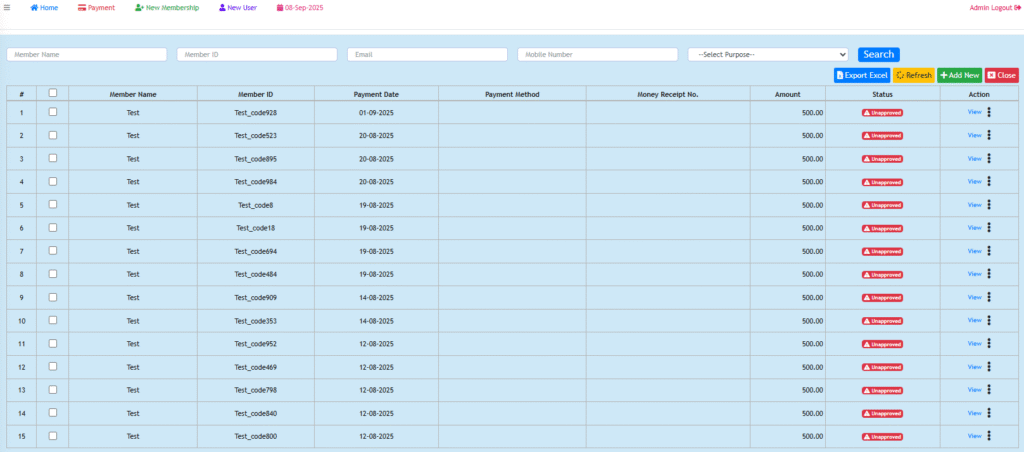
Every transaction is recorded with details such as amount, date, category, and the user who entered it. This creates an audit trail, making it easy to trace back and verify every financial movement.
3. Digital Receipts
Members receive digital receipts for payments. This reduces disputes and ensures that no income is left unrecorded.
4. Member Transparency
Reports can be shared digitally with members. Some systems even allow members to log in and view financial summaries anytime. This builds trust and reduces unnecessary questioning.
5. Regulatory Compliance
Many countries, including Bangladesh, require clubs and societies to maintain proper accounts for legal purposes. Club software makes compliance easy by generating reports in formats that can be directly submitted to authorities.
6. Secure Backup
Cloud-based club management systems automatically back up data. This means even if a local computer is damaged, records remain safe and accessible.
Real-Life Example: A Sports Club in Bangladesh
Let’s imagine a sports club in Dhaka that has 500 active members. Each member pays an annual fee of Tk. 5,000, generating Tk. 25,00,000 in income. On top of that, the club hosts tournaments and receives sponsorships from local businesses.
If the treasurer tries to handle all of this on paper registers, errors and disputes are almost guaranteed. Members may complain about where the money is going. Sponsors may demand proof of how their funds were used. Auditors may reject the books if receipts are missing.
Now imagine the same club using management software. Every payment is recorded with a receipt. Income and expense reports are generated monthly and shared with members. At the end of the year, the system produces an audit-ready report that satisfies both auditors and members.
The difference is not just convenience—it’s credibility and peace of mind.
Features to Look for in Club Management Software
Not all software is the same. When selecting a solution, clubs should consider features that directly support financial reporting and audits.
Key features include:
Income and Expense Tracking with categories
Member Database linked to payments
Digital Invoicing and Receipts
Multi-User Access with Permissions
Cloud Backup and Security
Audit Trail and Report Generation
Integration with Mobile Payments (Bkash, Nagad, etc. in Bangladesh)
The right software should be user-friendly so that even committee members without deep accounting knowledge can use it.
Final Word
Audit-ready reporting is not just about compliance—it is about building trust and credibility within the club. When members know that every taka is being recorded, tracked, and reported, they are more likely to stay loyal and even encourage others to join.
In Bangladesh and beyond, clubs that adopt modern management software enjoy smoother operations, fewer disputes, and stronger reputations, and that provided by MNP Techs Club Membership Management software.
In the end, a transparent financial system ensures that clubs can focus on what truly matters—community, culture, sports, and growth—without being dragged down by mistrust or accounting issues.